Valhalla Hills Review

Odin, Wodan, Wotan, Wotun, Allfather, Anthony Hopkins (pick any one of the hundreds of names he’s known by across the world) – the high god of the Norse pantheon and probably the best known god since the big one – is a dick. So begins Valhalla Hills.
Apparently, Odin isn’t particularly happy that one of his sons (you) prefers to settle down with a trowel and a Vaettir level on an evening rather than getting drunk and fighting people. He’s also rather annoyed at the quality of the heroes that have been rocking up in Asgard lately so he’s banished them all back into the mortal world to prove themselves and you’re going with them to show them how to… build and… stuff. In each level of Valhalla Hills you play a sort of cosmic town planner, helping to guide the beleaguered vikings to the portal that marks the end-point of each level, always hoping that this time Asgard will be on the other side of it – though, to pass through the portal, you’ll either have to appease the guards that watch over it with sacrifices or don your horned helmet and prepare to fight!
Valhalla Hills is an RTS but, in a similar vein to Populous, The Settlers and Funatic’s previous game, Cultures, with one quite important twist – you never actually get to control any units. You start off each level with a few surly vikings (beamed down from the doors of Valhalla where Odin’s still being a bit petty about how honourable they are) and, over the course of the level, you’ll suggest things for the vikings to do: maybe they’d like to build a tent here, a woodcutter here, maybe they’d like to pop up a quarry over there or a storage area or something. Once you’ve got a military camp, you can even suggest that a few of the vikings would like to be warriors but you still won’t be able to mess around with their free will.
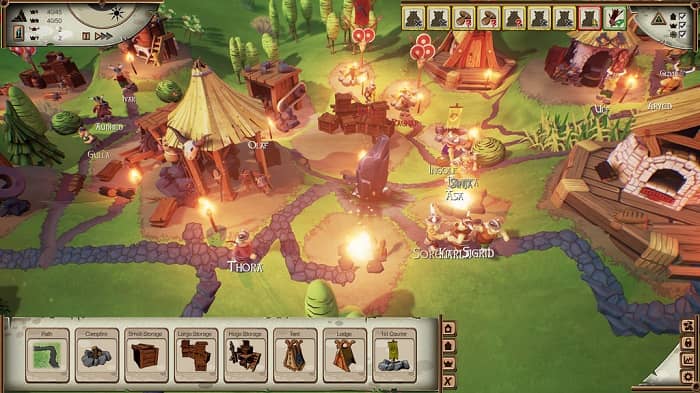
The building portion of the game is pretty great – like in some other RTSs, Funatics have gone for a semi-realistic approach to the functioning of a town with Valhalla Hills. You’re going to need to establish a properly functioning settlement before you can develop it into a bigger town, starting with basic needs – wood, tools, food – and then growing into small-scale industry (farms take their crops to the mill where it is ground into flour and then taken to the bakery to be made into bread) as your population grows. Space and resources are sparse on most levels – you need nice, flat ground to build on, and if it isn’t you’re going to be paying additional costs to pop a little plinth down to support the building. Since you can’t tell your vikings exactly what you want them to do, they’ll decide amongst themselves who’s going to do what and then hop to it – or not, as the case all too often is.
The vikings are, to a grizzly, bearded man and woman, bloody lazy. They love nothing more than lounging about and having a good old chat amongst themselves (providing you’ve encouraged one of them to build a campfire) or more aptly, lounging about and moaning about being hungry; something that my vikings seemed to do with increasing regularity as the game progressed. Food is probably one of the most difficult resources to juggle. As time passes you’re going to need to grow your population but even the lowest population needs at least a few fishing huts to remain sated and, if the vikings doing the fishing don’t really feel like working, you’re going to need to build a few more to keep the fishies coming. But more buildings means that you need more vikings and more vikings means less food to go around. When you’re trying to build up to some of the more complex structures you’re going to need more specialised manufacturers to create the materials and each basic resource gathered can go through several processes before it’s actually useful, meaning that you’re going to need more vikings to get you there (and more vikings means…? That’s it: more food!).
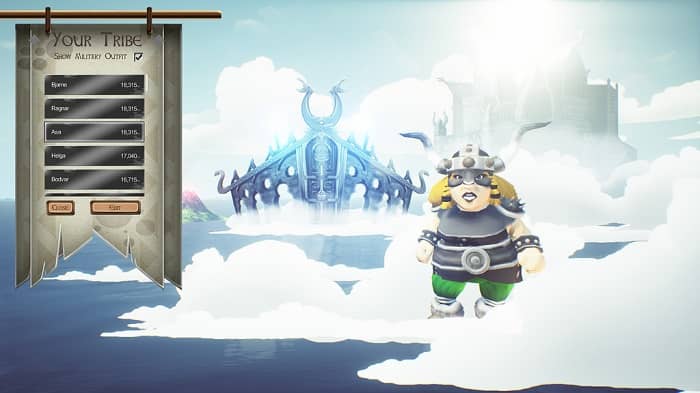
Playing Valhalla Hills the “proper” way is hard. Even on the easier levels I sometimes struggled to get the build order right and ended up watching the vikings starve to death because no one was getting enough food so no one wanted to work and they all stood around the campfires talking smack about me – despite the fact that I was screaming at the screen for one of them to: “just bloody well do something!” It’s not only the order of your buildings that you’ve got to watch out for though, as your lack of direct control over your minions means that you’ve got to trust that they’re going to do what you want them to; especially if you start thinking of this like any other RTS and try to order several buildings at once. While the vikings will try to build the buildings in the order that you requested them, what usually happens is that one builder will stop working for the day so another builder will go and grab some resources to make their building but, if there aren’t enough to go around, you’ll end up with two unfinished buildings and no resources.
Unfortunately, this doesn’t just apply to building. Any manufacturer that requires resources to work will stockpile them for later use, so your tool maker will nab logs, sticks, leather, etc. just in case you need them to make a fishing rod or whatever, but the problem there is that several other places will want the same goods – the armourer for example – to make something else. In that case, you’re just stuck. There’s no way of getting one manufacturer to hand over the goods to another – no matter how many carriers you employ to cart the goods around. The only way to do it is to disable the building so that it can’t produce anything until all of the goods have been distributed elsewhere but, even then, you could be in exactly the same position as the one you started in.
Of course, there is another way to play. For the first few levels of Valhalla Hills I was devoting over half an hour to each – carefully growing my little settlement, trying to manage the resources, replenish trees and make sure that the animals weren’t over-farmed – before heading to the portal to take on the guards or building an altar to send guard-appeasing offerings. But then, I decided to try something new. Not something new in RTSs – this tactic has been around for as long as multiplayer gaming (possibly before) – but something new to my playthrough of Valhalla Hills, certainly. I tried a rush – and it worked. Maybe it’s because there weren’t that many enemies, but I had no trouble building up a little settlement then whacking down a load of houses and rallying the troops for an epic push up the icy slopes to the portal and victory, and it didn’t take long at all. The only problem was, it wasn’t very satisfying. So the next mission, I was back to land-management, cursing out the lazy SOBs who wouldn’t lift a finger to help build another farm and pretending that my little rush hadn’t happened.
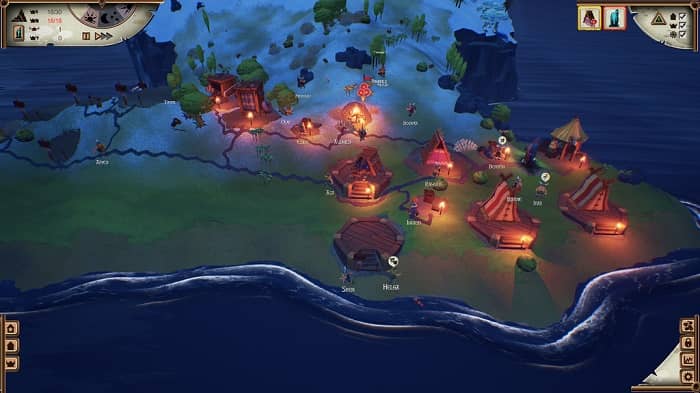
Though they are incredibly frustrating at times, it’s really the vikings themselves that make Valhalla Hills. They’re all a little different (or as different as you can get with a few criteria – beard, hair, shirt-colour – to randomise), have individual names and each seems as though they’re a unique character. Of course, this is helped by the fact that they each generate their own, individual, stock of honour and losing one means you’re probably taking a big step backwards in terms of completing the game. The fact that Valhalla Hills possesses some really rather nice graphics is another factor. They’re not amazing graphics; they’d look much, much better if you were playing the game on a tablet, say, but they’re incredibly charming and very well suited to the game as a whole. I can’t imagine that you’d be quite so forgiving of a photo-realistic, immaculately textured, performance-captured viking – probably because you’d be afraid of starting a fight with them – as you often will be of their cutesy but tough-looking Valhalla Hills counterparts. Likewise, the sound design is nice: while it’s not pushing any boundaries, it doesn’t feel out of place and just adds a little more life to the world that you’re playing in.
Not that Valhalla Hills ever really tells you what world that is. It doesn’t ever do a great job of telling you anything, really. When you start a new game you’re tossed into the first randomly generated level with some basic buildings at your disposal and a heck of a lot of text to wade through so that you can find out how to use everything. As you progress through the levels you’ll unlock new stuff (and new text) – not just buildings but enemies and a greater variety of map – until you’ve got blueprints coming out of your ears and frost-wolves clambering out of your nose. While this is a great way of introducing the more elaborate and intricate mechanics, Valhalla Hills isn’t ever really too explicit – it likes to let you figure things out. Like: don’t put the army camp too far away from the storage site because soliders are even more lazy than normal vikings and won’t go more than three feet to pick up their sodding axe; or the fact that you’ll need to leave room in your population to make soldiers, otherwise you’ll have an army of carriers milling around with goods all over the place as opposed to someone capable of fighting the enormous ice giants that are coming to smash up your hunting lodge. I still have no idea how the courier works.
I will say this for Valhalla Hills, though: it’s difficult to put down. I’ve said that before but, in this case, it’s absolutely true. Even when you’re in the most dire of situations – no food, people starving, portal teeming with guards who are getting too close for comfort – it’s incredibly hard to let go, sign off and call it a night. Maybe it’s because the vikings are so compelling to watch, maybe it’s the charm of the game or maybe it’s because, one of these days, the little buggers are going to start doing what I want and I’m damn well going to be here when they do…