
The Deed: Dynasty Review

The year is 1401.
William Bruce approaches the mansion of the man who ruined his life with one goal in mind. He grabs an axe and a firepoke, and… oh, dinner time. William sits upon these sharp implements at the dinner table with people he’s never met, saying nothing, plotting, scheming. After dinner, he climbs to the roof where he jabs his victim to death with the firepoke. Now he just has to plant the weapon with one of the other guests, so he can… oh, only three seconds before someone finds the body. Cool. Okay. Let’s just walk down the stairs and hide outside a child’s bedroom. Sure. Right. The sheriff soon arrives to unravel the mystery. And unravel it he does. You see, Mr. Bruce handled this murder poorly. But that’s okay. The Deed: Dynasty doesn’t exactly make it easy for things to go well.
This paragraph describes my first escapade into one of The Deed: Dynasty’s three brief scenarios. As you may surmise, this is a game about killing someone and getting away with it. Or, rather, killing someone, being 90% sure you’ll get away with it, and ending up being absolutely, totally wrong. You see, your first 20-minute run of the game provides all the learning curve you need. From then on, it’s pretty much a matter of how much “informed trial-and-error” you are willing to stomach.
Unlike me, if you don’t botch things up at the get-go, here’s how a standard playthrough of any of the three scenarios will go down: brief, skippable intro. Item collection phase where you are (theoretically) meant to collect one weapon and one piece of plantable evidence while questioning the other characters to discover hidden motives. A gathering scene where all those present take part in some sort of group discussion. The evidence-planting and murder phase, and finally, the questioning by law enforcement, wherein you must try and deflect suspicion towards your pasty. This routine keeps all three scenarios into a manageable format, but it also causes some stagnation, especially since the most surefire way to achieve any particular ending is to start anew each time without “pilot save files,” so to speak.
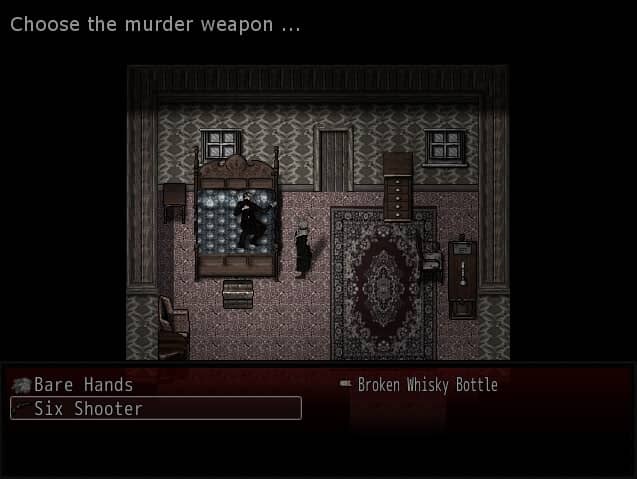
In fairness, most of my issues with The Deed: Dynasty are within the first scenario, described in the opening paragraph. This was the original incarnation of The Deed before the two 19th century scenarios were added to form the Dynasty. William Bruce’s lifelong vengeful mission may carry the most emotional gravitas of the three, but its hidden counters to determine guilt hate you. From the outset, Bruce is the only outsider. He hails from Scotland, so all the Englishmen and women instantly mistrust him. And due to these factors, when the sheriff shows up he basically only questions Bruce. Without peeking at the game’s code I can’t know for sure the degree of leniency, but it sure felt like one mistake spelled doom. This makes sense for the plot, but it frustrated me to near hair-pulling when I would scroll through a dialogue too fast, accidentally sympathize with heretics, and get put to death for it.
Like I said, the other two scenarios do a better job of stacking the odds. For example, in the third scenario I misclicked my answer for my location at the time of the murder and had another inconsistency based on a previous conversation. Despite this, I succeeded in foisting the guilt of the crime onto my bedridden, mentally disabled mother. In retrospect, maybe that’s not something to be proud of.
My criticisms of The Deed: Dynasty come from a place of well meaning. The concept is fantastic. The gameplay is functionally standard for RPG Maker games (even if the massive inventory boxes seem silly given that you can only carry two items). The music is appropriate to the settings, themes, and periods. I found the writing believable, expertly so, in fact. The characters veer away from most tropes and archetypes. They feel like actual people whom you have to merely portray as archetypal to fit your ends. Their designs, and the overall pixel-art aesthetic, are rich and grim, although their animations are a bit stiff.
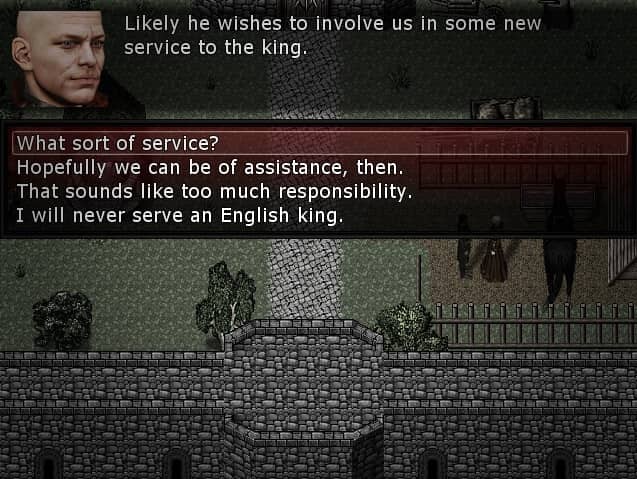
But for all that The Deed: Dynasty accomplishes, it is still highly reductive. Once you’ve “gotten away with it” once in each scenario, the only real reason to keep playing is to unlock the achievements. And at that point, even completing a run is just a formality. The characters telegraph their motives so clearly and the weapons/evidence combinations are so obvious, that it ceases to be a puzzle and becomes “Hold Shift to Win.” Even the endings are pretty bare. Your scapegoat puts up a tepid, lukewarm defense, then the story advances to give a couple of lines on what happened to them afterward. Like I said: it’s banal achievement-hunting.
Still, there are worse ways to spend an afternoon, and your first time choosing a target and setting them up can provide a decent dose of fun. It costs £1.99/$2.99 which equates to about one dollar per campaign. The amount of dialogue and setup options alone make up that price. Ultimately, its value depends on your patience and capacity for high repetition. For me, I wasn’t terribly keen on The Deed: Dynasty, but I can see these developers heading in a promising direction, and I hope to see more of what they have to offer in the future.